The moment
18 Oct 2026, a dim café. A LinkedIn job alert in Yahoo Mail on a MacBook Pro: one company logo glowed far brighter than anything else on screen. A screenshot of it looked completely normal.
Investigation
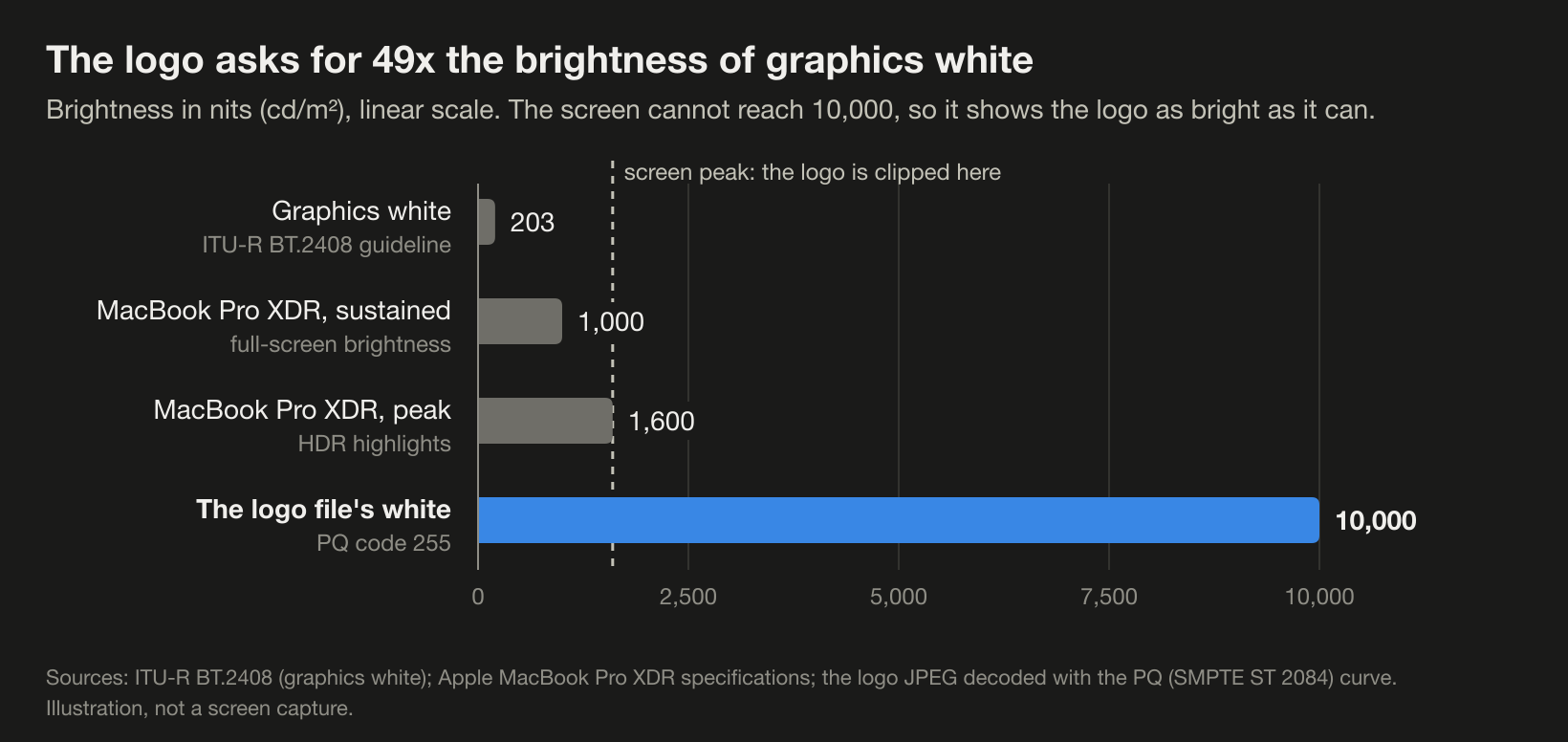
- Read the JPEG's bytes: an Apple "BT.2100 PQ" ICC profile (CICP 9/16/0/1). The logo's white is PQ code 255, which means 10,000 nits, about 49x the 203 nit graphics white in ITU-R BT.2408.
- Explained the screenshot puzzle: screenshots are tone-mapped to SDR, so the glow never appears in reviews or bug reports.
- Found the gap: authors can cap HDR (
dynamic-range-limit) and test for it (@media (dynamic-range)), and the spec says browsers "should" offer a user limit, but no user preference exists. - Measured adoption from Chrome Platform Status:
prefers-reduced-motionon 58.3% of page loads,dynamic-range-limiton 0.66%. - Borrowed a precedent from audio: loudness normalization (BS.1770, EBU R128, the US CALM Act, Spotify's levels).
What I built
- An explainer in three reading levels: technical, balanced and plain language.
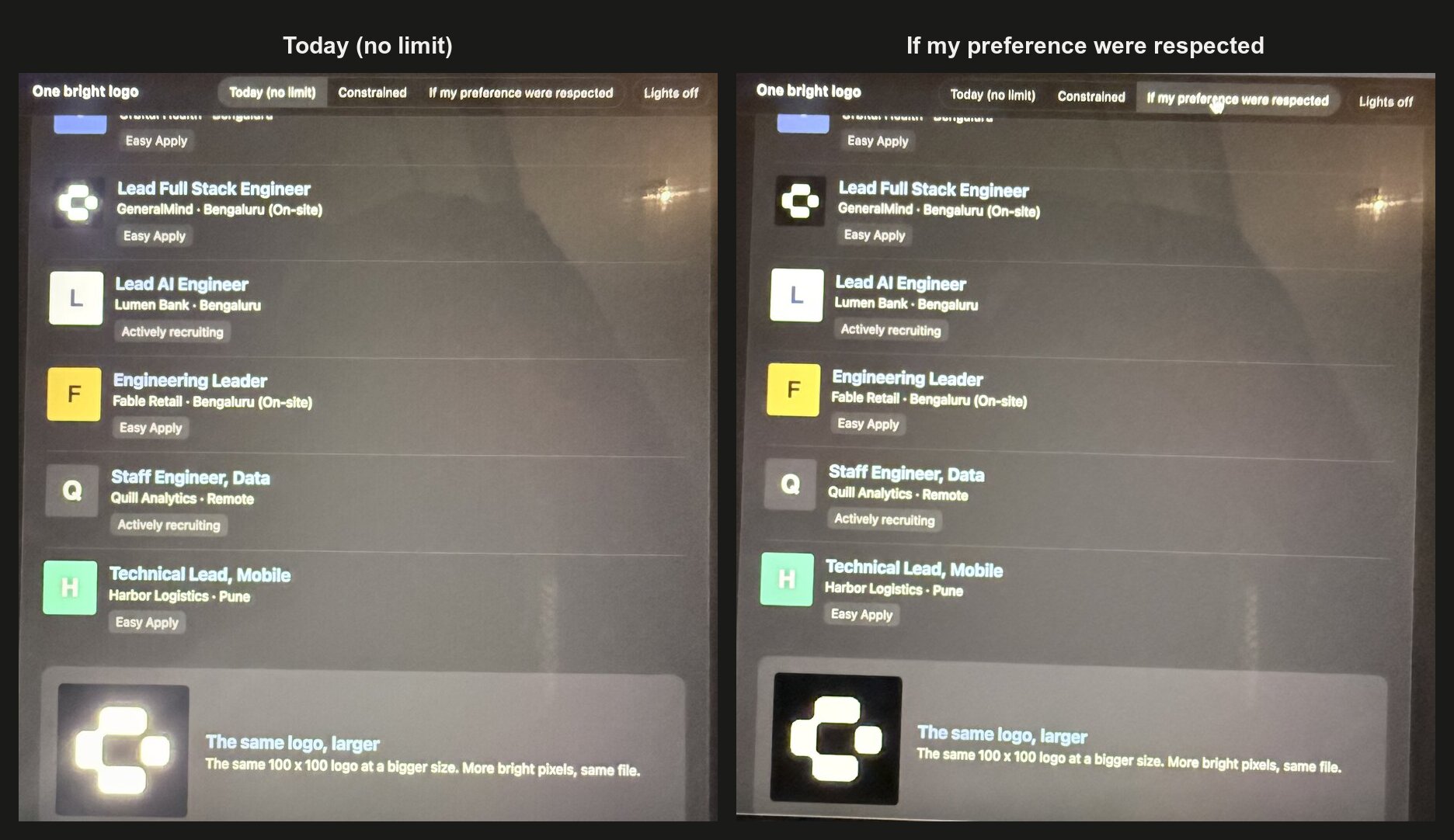
- A live demo that recreates the inbox with the original logo file, with a toggle between today's behavior, a constrained cap and "if my preference were respected".
- Evidence that works on any screen: a brightness chart, and phone photos (since screenshots can't show HDR), as an animation that falls back to a still image for people who prefer reduced motion.
The proposal
- 01A browser or OS override that caps HDR brightness and that pages can't undo.
- 02A media feature (
prefers-reduced-peak-brightnessorprefers-dynamic-range) so authors can adapt design, not just brightness.
Outcome so far
- Filed as w3c/csswg-drafts#14616 on 18 Oct 2026, cross-linked from the existing discussion in #11790.
- Shared on LinkedIn with a call for use cases.
- [Update as it happens: CSSWG replies, browser tickets, use cases collected.]
Learnings
- Accessibility bugs can be invisible to the tools we review with. Screenshots hid this one completely.
- The harm is relative, not absolute: a spike against its surroundings, which is why dimming the whole screen doesn't help.
- Standards move on evidence and use cases, so lead with a real case, numbers and a demo anyone can try.
- Practice what you propose: the explainer's own animation respects
prefers-reduced-motion.